Version
unreleased
Published on
Jan 27, 2026
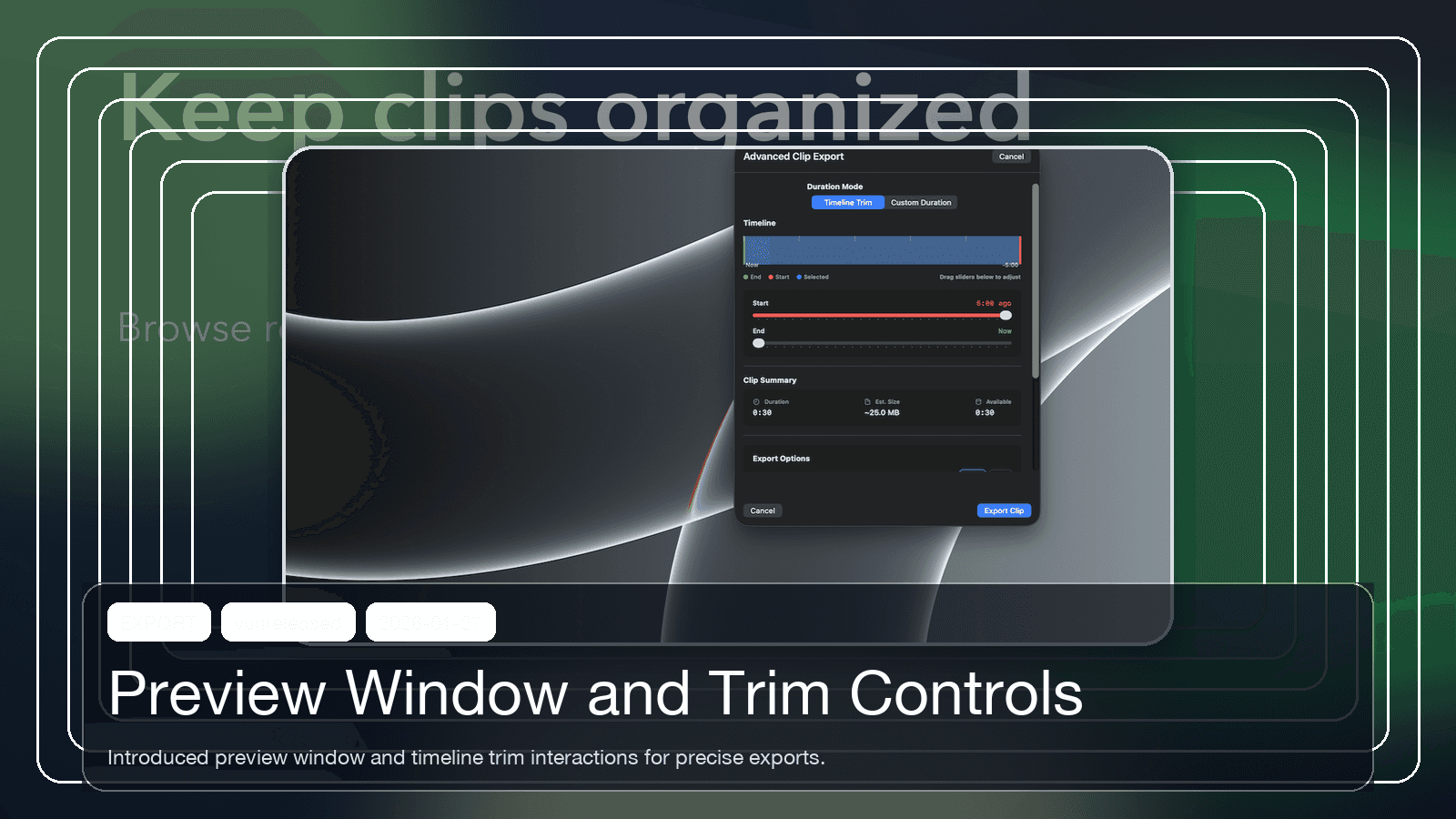
Preview Window and Trim Controls
Preview Window and Trim Controls
Context
This entry captures the implementation journal for Preview Window and Trim Controls, completed on 2026-01-27 under version marker unreleased. Category: Export. Scope reference: 4 files changed, 395 insertions. Users needed confidence before export, especially when selecting precise time ranges from rolling history. The objective in this phase was to turn intent into predictable behavior and to document decisions so later iterations can build on stable ground. This mattered not only for feature delivery, but also for long-term operability.
The immediate mission for this release was to close the gap between product intent and reliable runtime behavior. I treated the changelog as an engineering journal, meaning I documented why each decision was made, what technical boundaries were adjusted, and how I validated expected outcomes before moving forward. This record is meant to be useful months later when revisiting architecture choices, debugging regressions, or revisiting the reasoning behind this stage of the product from a solo-development perspective.
Build Journal
I focused heavily on adding preview window playback for pre-export confidence. Execution was intentionally iterative: I started with the minimal reliable path, then expanded behavior once instrumentation and state handling were clear. That sequencing prevented hidden coupling from spreading across unrelated modules and made code review more decisive. Within the context of Preview Window and Trim Controls, this work improved confidence in both immediate functionality and future extensibility.
One of the most consequential implementation threads was introducing trim controls for range precision. Execution was intentionally iterative: I started with the minimal reliable path, then expanded behavior once instrumentation and state handling were clear. That sequencing prevented hidden coupling from spreading across unrelated modules and made code review more decisive. Within the context of Preview Window and Trim Controls, this work improved confidence in both immediate functionality and future extensibility.
I focused heavily on improving interaction flow between selection and export. Execution was intentionally iterative: I started with the minimal reliable path, then expanded behavior once instrumentation and state handling were clear. That sequencing prevented hidden coupling from spreading across unrelated modules and made code review more decisive. Within the context of Preview Window and Trim Controls, this work improved confidence in both immediate functionality and future extensibility.
I focused heavily on aligning preview state with clip preparation logic. Execution was intentionally iterative: I started with the minimal reliable path, then expanded behavior once instrumentation and state handling were clear. That sequencing prevented hidden coupling from spreading across unrelated modules and made code review more decisive. Within the context of Preview Window and Trim Controls, this work improved confidence in both immediate functionality and future extensibility.
I focused heavily on reducing ambiguity in final output boundaries. Execution was intentionally iterative: I started with the minimal reliable path, then expanded behavior once instrumentation and state handling were clear. That sequencing prevented hidden coupling from spreading across unrelated modules and made code review more decisive. Within the context of Preview Window and Trim Controls, this work improved confidence in both immediate functionality and future extensibility.
Validation And QA Notes
Validation covered trim interaction tests across short and long ranges. Rather than treating testing as a final gate, I used it as a continuous feedback loop during implementation. This approach helped expose state-transition issues early, especially where UI, background capture behavior, and persistence intersect. The result for preview-window-and-trim-controls was higher confidence that the shipped behavior matches the intended user story under normal and edge conditions.
Validation covered preview-to-export consistency checks. Rather than treating testing as a final gate, I used it as a continuous feedback loop during implementation. This approach helped expose state-transition issues early, especially where UI, background capture behavior, and persistence intersect. The result for preview-window-and-trim-controls was higher confidence that the shipped behavior matches the intended user story under normal and edge conditions.
Validation covered range boundary correctness validation. Rather than treating testing as a final gate, I used it as a continuous feedback loop during implementation. This approach helped expose state-transition issues early, especially where UI, background capture behavior, and persistence intersect. The result for preview-window-and-trim-controls was higher confidence that the shipped behavior matches the intended user story under normal and edge conditions.
Validation covered manual UX passes for precision workflows. Rather than treating testing as a final gate, I used it as a continuous feedback loop during implementation. This approach helped expose state-transition issues early, especially where UI, background capture behavior, and persistence intersect. The result for preview-window-and-trim-controls was higher confidence that the shipped behavior matches the intended user story under normal and edge conditions.
Tradeoffs And Decisions
A notable tradeoff in this cycle was richer preview controls increased UI complexity. I accepted this deliberately because long-term reliability and maintainability were prioritized over short-term convenience. In my reviews, I chose explicit boundaries and clearer failure handling, even when the implementation became more verbose. That decision aligns with the product direction of predictable capture behavior over fragile implicit magic.
A notable tradeoff in this cycle was precise trim handling requires stricter edge-case logic. I accepted this deliberately because long-term reliability and maintainability were prioritized over short-term convenience. In my reviews, I chose explicit boundaries and clearer failure handling, even when the implementation became more verbose. That decision aligns with the product direction of predictable capture behavior over fragile implicit magic.
A notable tradeoff in this cycle was interactive preview added rendering overhead considerations. I accepted this deliberately because long-term reliability and maintainability were prioritized over short-term convenience. In my reviews, I chose explicit boundaries and clearer failure handling, even when the implementation became more verbose. That decision aligns with the product direction of predictable capture behavior over fragile implicit magic.
Next Iteration Plan
Looking ahead, the immediate follow-up is to improve marker-assisted range selection. This next step builds directly on the foundations laid in this milestone and should be measured with the same pragmatic reliability lens. I also expect documentation and test coverage to evolve alongside the implementation so behavior stays transparent as complexity grows. Capturing these next moves now keeps momentum focused and reduces ambiguity in subsequent release planning.
Looking ahead, the immediate follow-up is to optimize preview load performance. This next step builds directly on the foundations laid in this milestone and should be measured with the same pragmatic reliability lens. I also expect documentation and test coverage to evolve alongside the implementation so behavior stays transparent as complexity grows. Capturing these next moves now keeps momentum focused and reduces ambiguity in subsequent release planning.
Looking ahead, the immediate follow-up is to expand export format guidance in-context. This next step builds directly on the foundations laid in this milestone and should be measured with the same pragmatic reliability lens. I also expect documentation and test coverage to evolve alongside the implementation so behavior stays transparent as complexity grows. Capturing these next moves now keeps momentum focused and reduces ambiguity in subsequent release planning.
Closing Reflection
This milestone is best understood as part of a cumulative reliability and usability arc. Each change added practical value, but the larger benefit comes from consistency across engineering execution, QA discipline, release operations, and user communication. By preserving this level of detail in the changelog journal, I keep context accessible and reduce repeated decision churn in future cycles.